Scared and Doing It Anyway: How to Be Brave When You're Anxious
There's a phone call on your to-do list. It's been there for three weeks. It would take four minutes. And every day, you look at it, feel your stomach drop a little, and move it to tomorrow.
If that sounds familiar, you're in good company.
What does it mean to be brave when you have anxiety?
Being brave with anxiety means feeling scared and doing the thing anyway. You don't have to wait for the fear to go away first. Bravery is choosing to move toward something hard while the fear is still there.
That might mean signing up for the class, saying the honest thing, or finally making that call. It doesn't have to be heroic. Some days, brave looks like showing up to an appointment.
The two mistakes anxiety tends to make
Anxiety is persuasive, but it isn't always accurate. Psychologists have known for decades, going back to Aaron Beck's cognitive model of anxiety, that anxious thinking tends to do two things:
It overestimates how likely it is that something will go wrong.
It underestimates your ability to handle it if it does.
Put those two together and avoiding the thing makes a lot of sense. It just doesn't help.
Why waiting to feel less scared doesn't work

A lot of people believe they need to feel ready before they act. Less nervous. More confident. Then they'll do it.
The problem is that confidence usually shows up after the brave thing. Avoiding feels like relief in the moment, but it never gives your brain the chance to learn that you're more capable than anxiety claims.
That's why approaching what scares you sits at the heart of many evidence-based anxiety treatments, including exposure therapy. When you face the thing, it's often not nearly as bad as you predicted. Or it is hard and you handle it anyway. Maybe messily. Maybe without much grace. But you handled it. And if it goes badly, that's information too. It doesn't mean you can't do hard things.
For fears tied to trauma, panic, or OCD, it's worth doing this with a therapist, who can help you pace it.
And once you've handled one hard thing, it's easier to ask yourself: if I could handle that, what else could I handle?
The cost of a shrinking world
Avoidance makes your world smaller. One skipped conversation becomes two. One avoided place becomes a whole part of town you don't visit anymore.
Scary is unavoidable. Even if you did absolutely nothing, your mind would still find something to worry about. But the more you approach things, the bigger something has to be before it even registers as scary.
When avoiding something is actually wise
Brave doesn't mean reckless. If something is truly dangerous or harmful with no real upside, steering clear is good judgment. That includes people. If a conversation could put you at real risk, protecting yourself is the brave choice.
The tricky part is that anxiety and our love of comfort can make "uncomfortable" feel exactly like "unsafe." Learning to tell the difference is part of the work, and it's something a therapist can help you sort out.
Try it: 7 Nights of Brave
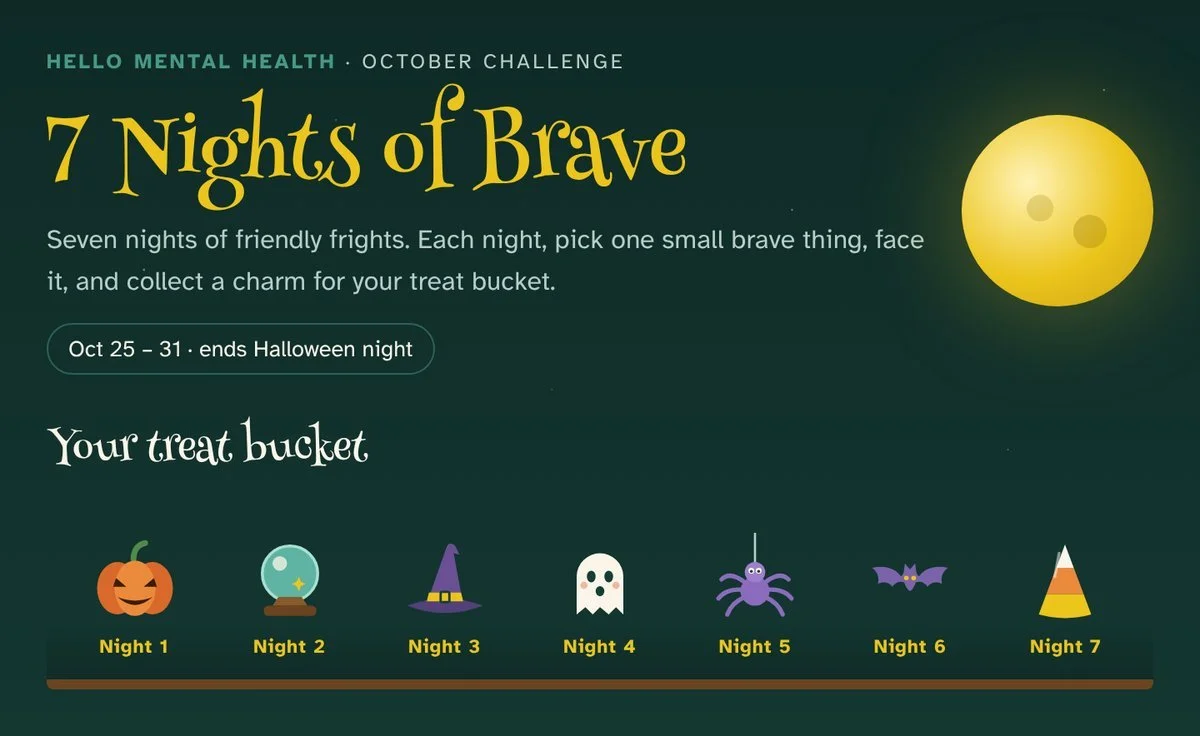
If you want a low-pressure way to practice, join us for 7 Nights of Brave, running October 25 through Halloween night.
Each night, you pick one small brave thing, face it, and collect a charm for your treat bucket. You can do the nights in any order, and you can skip or repeat any of them. Fun-size challenges count just as much as the big ones, and the frights are meant to be friendly.
By Halloween night, you'll have seven small reminders that you can do hard things while you're scared.
Frequently Asked Questions
Is it normal to feel scared even when nothing bad is happening?
Anxiety often sounds the alarm before there's any real danger. Feeling scared doesn't always mean something is wrong, and it doesn't mean you can't act.
How do I start being brave if I'm anxious?
Start small. Pick one thing that feels a little uncomfortable but doable, like a phone call or an email you've been putting off. Small wins build on each other.
Does avoiding things make anxiety worse?
Over time, it often does. Avoidance brings short-term relief, but it keeps your brain from learning that you can cope, which can help the fear stick around.
When should I talk to a therapist about anxiety and avoidance?
If fear is keeping you from things that matter to you, like work, relationships, or appointments, it's worth reaching out. Our Cincinnati anxiety therapists can help you figure out what's worth approaching and how to do it at a pace that works for you.
Pick one small thing for night one. You're allowed to be scared while you do it. 👻
If you're in crisis in the US, call or text 988 any time.
Bailey C. Bryant, Psy.D. is the Founder and Steward of Hello Mental Health, a group therapy practice in Cincinnati, Ohio.
This post is for educational purposes only and does not constitute a clinical diagnosis or replace individualized care from a licensed provider.