Is It Burnout or Depression? A Psychologist Explains the Difference
Workplace burnout is a legitimate phenomenon recognized by the World Health Organization, and a 2025 Forbes study found that 66% of U.S. employees have experienced it. But it's still one of the most misidentified experiences people bring into my office.
It gets mistaken for depression. It gets blamed on weak self-discipline or poor self-care. And most people try to push through it, which is exactly the wrong approach.
Here's what burnout actually is, why it's so easy to misread, and what recovery actually looks like.
It's Not a "You" Problem. But It's Not That Simple, Either
Here's the thing I find myself saying a lot: burnout is not just a self-care failure. It's not because you're too "soft", not meditating enough, or not disciplined about your sleep schedule. Those things matter but they're not the whole story.
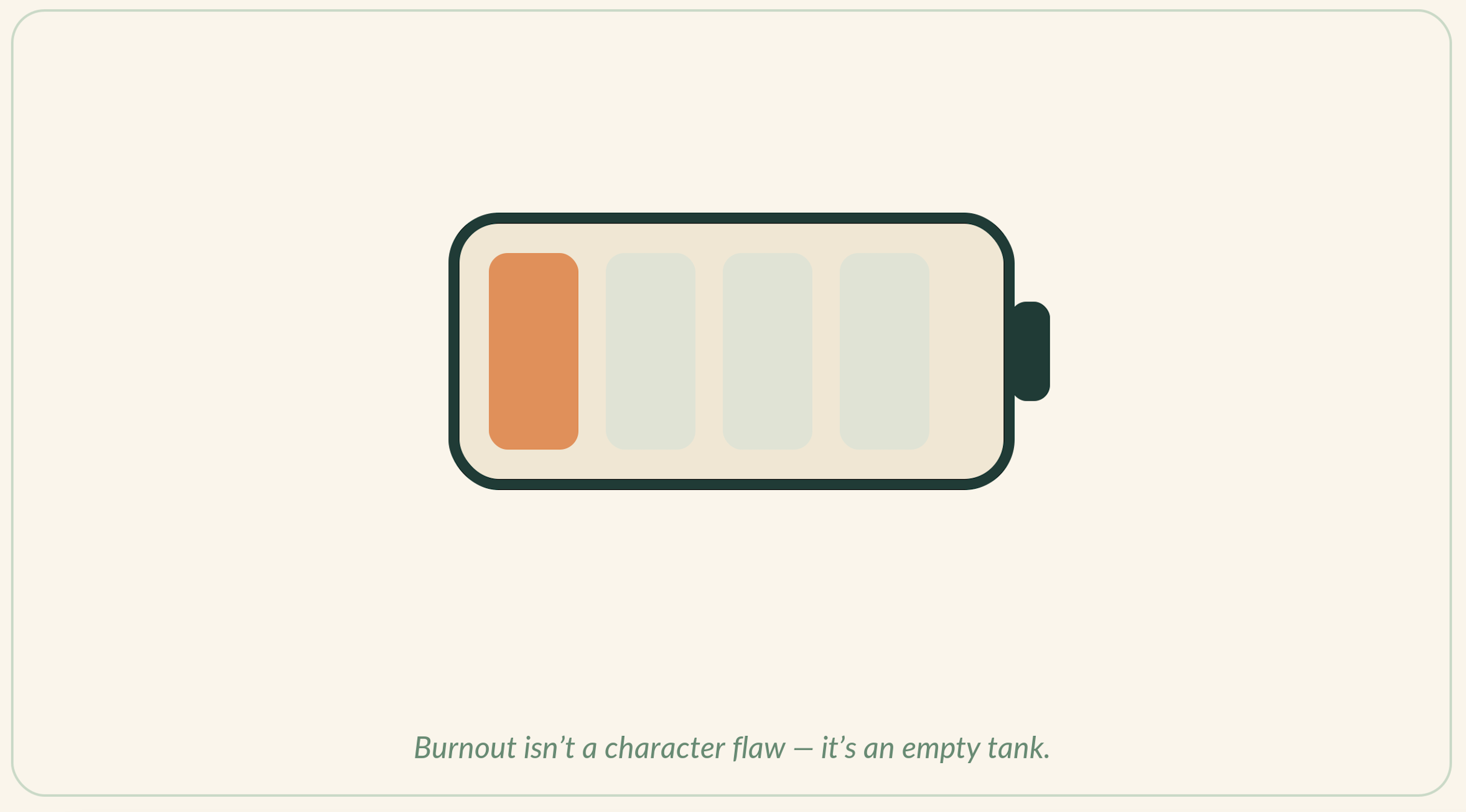
Burnout happens when you've experienced heightened stress for a prolonged period of time that your usual coping strategies can't adequately manage. Your internal resources get depleted to the point where there's simply nothing left. That's not a character flaw. That's an empty tank.
At the same time, burnout isn't always entirely a systems problem, either. It's rarely that black and white, all you, or all the environment. Usually it's both. And the honest, productive question is: what can actually be changed here, and by whom?
Why It Gets Mistaken for Depression
This is where things get really tricky.
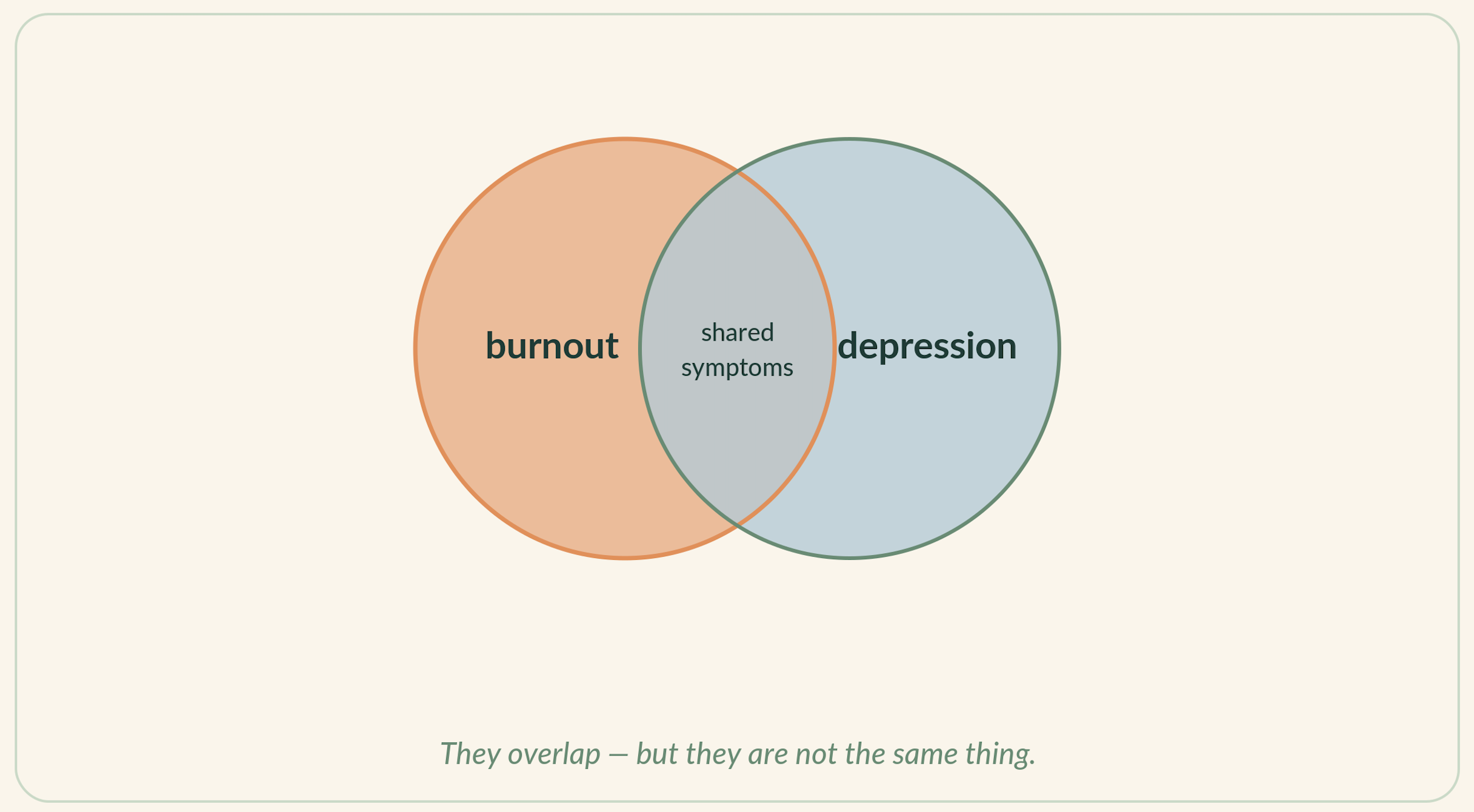
Burnout and depression share a lot of the same surface-level symptoms. Low energy, loss of interest, disconnection, difficulty concentrating, that flat "what's the point" feeling. They can absolutely co-occur. But they're not the same thing, and that distinction matters enormously for how you treat them.
With depression, one of the most evidence-based approaches is behavioral activation: doing things, getting moving, engaging with life even when you don't feel like it. With burnout? Sometimes the treatment is actually doing less. Rest isn't avoidance. It's part of the recovery.
I know this firsthand. I spent a season of my own life convinced I was depressed. I tried therapy, medication, yoga, journaling, every wellness practice I could think of. Some of it helped at the margins. None of it "fixed it." Eventually I had to sit with the uncomfortable truth that the environment I was in was asking more of me than I was capable of giving, and no amount of self-optimization was going to change that. For me, the answer was a change of venue.
That's not the case for everyone. I've seen people work through burnout by moving to a different project or team, changing how they structure their day, reconnecting with the meaning behind their work, setting firmer limits on their time and energy, or investing more in a personal life that actually fills them up. There are a lot of paths through burnout, but you do have to take a path.
What Happens If You Don't
Here's what I really want you to hear: pushing through burnout doesn't work. It makes things worse. The longer it goes unaddressed, the more depleted you become, and the longer and harder the recovery becomes.
If you've been white-knuckling it and wondering why nothing is getting better, that might be exactly why.
Burnout can hit high achievers especially hard. If your sense of identity and worth is closely tied to what you do, and suddenly doing it doesn't feel meaningful anymore, it can spiral into something genuinely existential. Who am I if this doesn't fulfill me? That's a heavy place to be, and it deserves real support, not just a better morning routine.
The World Health Organization recognizes burnout as a syndrome rooted in chronic workplace stress that hasn't been sufficiently managed. It's real. It's identifiable. And it's treatable when you treat it correctly.
The First Step
Start by getting curious about what's actually happening. Is this burnout? Depression? Both? A situation that needs to change, a way of working that needs to shift, or some of each?
You don't have to sort that out alone. If any of this resonates with you, connecting with a therapist who can help you figure out what you're dealing with, and what to do about it, is a really good place to start.
You deserve more than just surviving until Friday.
Bailey C. Bryant, Psy.D. is the founder of Hello Mental Health, a group therapy practice in Cincinnati, Ohio.
This post is for educational purposes only and does not constitute a clinical diagnosis or replace individualized care from a licensed provider.